Smart Ward Display Solutions for Hospitals | FVASEE

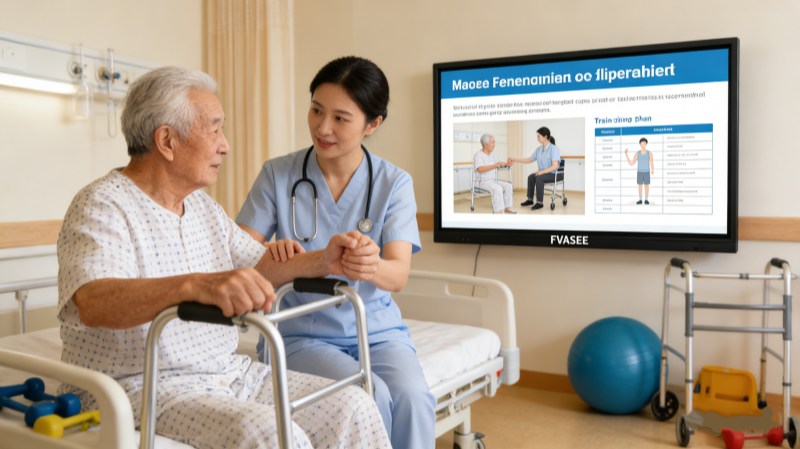
Smart Ward Display Solutions for Modern Hospitals
Coordinating care, communication, and information flow across hospital wards with digital displays
Introduction
A hospital ward is more than a collection of patient rooms. It is a shared clinical environment where nurses, physicians, and support staff coordinate care across multiple patients, shifts, and workflows.
As hospitals increase patient volume and care complexity, traditional paper boards and fragmented communication tools are no longer sufficient. Smart ward display solutions provide a centralized, visual layer that supports coordination, awareness, and efficiency across the entire ward.
FVASEE smart ward display solutions help healthcare facilities manage information flow at the ward level while remaining compatible with patient room and hospital-wide systems.
What Defines a Smart Ward Display System?
A smart ward display system consists of digital displays deployed across shared ward spaces, designed to present operational, clinical, and informational content relevant to staff and patients.
Typical locations include:
Nurse stations
Ward corridors
Shared clinical work areas
Staff coordination zones
Unlike patient room displays, smart ward displays focus on team awareness and workflow visibility, rather than individual patient education.

Key Functions of Smart Ward Displays
Supporting Care Team Coordination
Ward-level displays provide care teams with a shared visual reference, reducing reliance on verbal updates or handwritten notes. This supports smoother shift changes and clearer task alignment.
Improving Information Visibility
Important information—such as ward status, schedules, or care priorities—can be displayed consistently, helping staff quickly understand the situation without accessing multiple systems.
Reducing Communication Gaps
By centralizing key updates on digital displays, smart wards reduce the risk of miscommunication caused by outdated or incomplete information.
Display Types Commonly Used in Smart Wards
FVASEE smart ward solutions typically combine multiple display types, each serving a specific purpose within the ward environment.
Nurse Station Displays
Displays at nurse stations act as coordination hubs, supporting awareness of ward activity and shared responsibilities.
Corridor and Zone Displays
Corridor displays provide quick-glance information that supports movement and orientation within the ward, without exposing sensitive patient details.
Staff-Facing Information Screens
Staff-only displays can be configured to support internal communication, training reminders, or operational updates relevant to the ward.
Designed for Clinical Environments
Smart ward displays must operate reliably in busy clinical settings. FVASEE display solutions are designed with practical hospital requirements in mind:
Commercial-grade panels suitable for continuous operation
High visibility in varied lighting conditions
Secure mounting for high-traffic areas
Compatibility with centralized content management systems
These features support long-term deployment across wards with minimal maintenance overhead.
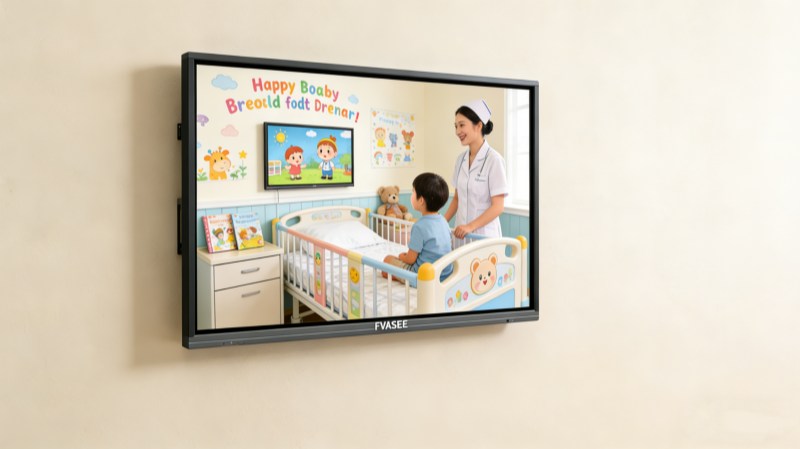
Integration with Patient Room and Hospital Systems
Smart ward displays are most effective when they complement, rather than replace, other healthcare display layers.
In a unified healthcare display ecosystem:
Patient room displays focus on individual communication
Smart ward displays support team coordination
Hospital-wide displays manage public information and navigation
FVASEE smart ward solutions are designed to fit naturally into this layered structure, allowing hospitals to scale digital communication without overlap or confusion.
Scalability Across Departments
Hospitals often deploy smart ward displays incrementally, starting with high-activity departments. Display solutions must therefore support flexible expansion.
FVASEE smart ward displays can be rolled out ward by ward, using consistent hardware standards while adapting content to each department’s operational needs.
Supporting Operational Efficiency and Care Quality
By improving visibility and coordination at the ward level, smart display systems contribute to smoother workflows and reduced administrative friction.
Clear, shared information helps care teams focus on patient care rather than information chasing, supporting both efficiency and quality outcomes.
Conclusion
Smart ward display solutions provide hospitals with a structured way to manage information and coordination across shared clinical spaces. By introducing digital displays at the ward level, healthcare facilities enhance communication, reduce errors, and support more efficient care delivery.
FVASEE smart ward display solutions help hospitals build connected, scalable digital environments that bridge patient rooms and hospital-wide systems.